
Shawn Parker, a longtime NASCAR pit crew member and part of Jeff Gordon’s legendary “Rainbow Warrior” team, has experienced nearly every side of the sport. From changing tires for Cup Series winners to competing in Legend Cars on Charlotte Motor Speedway’s quarter-mile, Parker has built a reputation for hard work, determination, and wisdom. His journey began alongside Gordon’s #24 DuPont Chevrolet Monte Carlo, an iconic paint scheme designed by the late Sam Bass, and it’s a story that shows how opportunity in racing extends far beyond the driver’s seat.
“I did NASCAR for 18 years. I had some decisions to make in 2003 when tragedy hit our family, so I stepped away from racing for a little bit and took a lesser-responsibility job, I suppose you can call it, moving into the car business. My father-in-law was a dealer in South-Central Kentucky, so I help with the family business for a living now.”

Getting involved in racing is very often not about what you know, but who you know and Parker’s connections helped him obtain a long-term, fulfilling career, getting started with the young Hendrick Motorsports in his twenties.
“I graduated from high school in 1992, and as I was in my hometown of upstate New York, I had a couple of people near me who were already on the dirt track scene and had already lived in Charlotte. During the end of my senior year, I wondered what I was going to do after school. College was not on my radar, but racing was, so I reached out to Bob Lutz of Fast Track Driving School, and Andy Hillenburg was the owner,” Parker proudly recalls of his networking. “I reached out to him (Lutz) during school and told him what my interests were, prompting him to let me come down during spring break and tour me around the shop. He got me a few interviews, and one of the interviews I got was at Hendrick Motorsports in the engine shop with Randy Dorton. This took place around late March or early April, so I had a few months of school left, but when I was called by Randy (Dorton), he told me, ‘If you want the job, you can have it.’ I did a lot of odd jobs with the engine builders, including tearing motors down, cleaning parts, just doing anything I could fit in.”

Parker’s grind didn’t stop after getting the job working on engines, he was hungry and when opportunity arises, you jump at the chance to show what you’re made of to advance in your career and take advantage of new opportunities.
“Jeff Gordon was coming in and a new team was in development, and with the first scheduled race taking place at Atlanta Motor Speedway (now known as EchoPark Speedway) in 1992, they (Hendrick Motorsports) were having tryouts to be pit crew members. I talked to Ray (Evernham) and let them know I’d like to try out, since they had a try out period. Every night after work, I’d drive my car down to their shop, which was on the other end of the complex and we’d have work outs and would learn from pit practices. This took place in August, so we had a couple of months before our first race and I ended up becoming the rear tire changer for the #24 Chevrolet. Back then, we had three tire changers. You had the front tire changer, a right-rear tire changer and a guy who did the left-sides, which basically meant he busted the lug nuts off the left-front and slid to the left-rear and changed the left-rear tire. I held the right-rear tire changer position for that race and for the duration of the next season as well.”

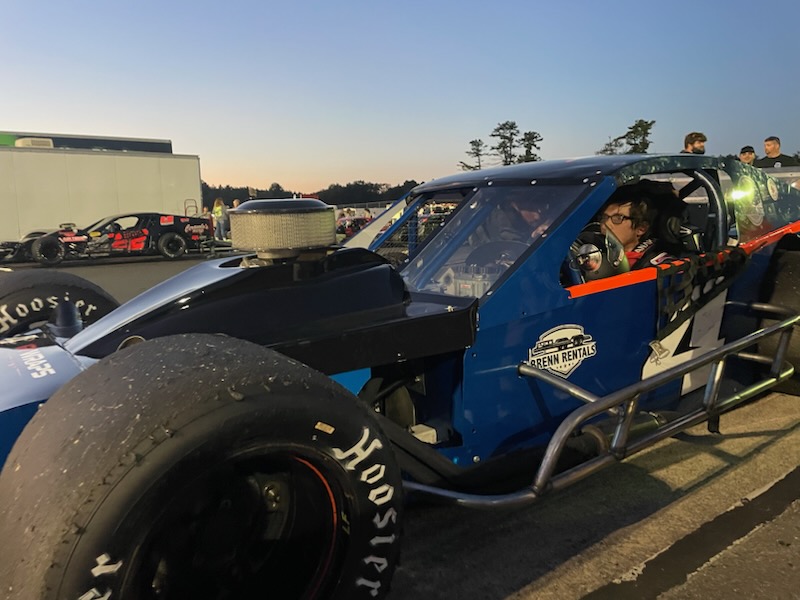
Parker races as a hobby every year, running the duration of ten races every week in the Cook Out Summer Shootout at Charlotte Motor Speedway. The Summer Shootout consists of hungry drivers who are looking to prove themselves before climbing up the ranks of NASCAR and guys who are racing as a hobby as a pastime. Parker travels from Kentucky to North Carolina every year to compete in the weekly annual contest.
“As far as racing in the Summer Shootout, it was mainly about the experience of racing with other friends in the NASCAR industry and now that I’m living in Kentucky, I mainly see them on TV or through social media and a few phone calls here and there. I kinda lost connection with a few of them, since it’s a grind to be on the road with NASCAR, so to be there for ten weeks of the Summer Shootout every day, being over there and getting to see everyone, the competition was fierce. I wasn’t fond of the rain and the back-and-forth, but I enjoyed it and it was definitely a great experience and I look forward to coming back next year.”

Parker wouldn’t consider this path a dream. Racing was the only option for him, proving that if you want something, you’ll create a way and make it happen, regardless of the path everyone around you is taking.
“I just wanted to work in racing. I didn’t care what it was, I just wanted to be in NASCAR. I had a conversation with my parents at the time, letting them know ‘college is great, but what am I going to go to college for?’ I felt it was easier to save money rather than spend money at college and learn it as a skilled trade. I wouldn’t recommend anyone wanting to work in racing skipping out on college nowadays, since the landscape has changed. We now have many types of skilled trade programs, including NASCAR Technical Institute and University of Northwestern Ohio (UNOH) and I would recommend that in today’s world, since they have a lot of openings that can help you get started in the racing world. I was very lucky and fortunate to have taken the path I took and it would not be as easy to get the job today, especially since NASCAR has become more of an engineered-based industry since I worked in it.”
With Parker having been retired for almost two decades from traveling with race teams, he forever brings with him a lot of memories, friends for life and moments that many people can only dream of experiencing.
“Winning your first race as a pit crew member is something you cherish forever. I was fortunate to be part of Jeff Gordon’s first career win, to stand in Victory Lane at NASCAR’s backyard, Charlotte Motor Speedway, after winning the Coca-Cola 600, and to celebrate the inaugural Brickyard 400 at Indianapolis Motor Speedway. I also had the privilege of working with Mark Martin, who is phenomenal both on and off the track, as well as Roger Penske and Rusty Wallace. Looking back, the impact these experiences had on me growing up is what inspires me to share these stories today.”

“To the young ones dreaming of entering this sport, I’ll say this: there are pictures, rings, and trophies, but you truly have to live it to appreciate it. Winning becomes the fuel that drives you to keep going, again and again. I’m deeply grateful for every opportunity I’ve had in my career, and that’s something nobody can ever take away from me.”


 Every Man on Every Crew, LLC.
Leave a comment