Last night’s Cook Out 400 at Richmond Raceway in Richmond, VA was a great race overall. What was not great was the finish of the 400-lap event. NASCAR gave the Cup Series the option to use a “softer” tire, which created a lot of strategy and gave the fans more battles throughout the field, a lot of action and a good strategy-filled race.
Denny Hamlin started on the pole with his teammate, Martin Truex Jr. on the outside. Their other Joe Gibbs Racing teammate, Christopher Bell, would wind up winning Stage 1 after taking the lead on lap 47, while utilizing the yellow “Prime” tire, as NBC called this standard tire that’s used regularly. Rick Ware Racing’s Justin Haley, fought to stay on the lead lap, as did Front Row Motorsport driver, Michael McDowell. Stage 2 saw Trackhouse Racing’s Daniel Suarez take the red “Option” tire on the restart, going all the way up from 16th-place to first in 14 laps. Clearly, the soft red tire was proving to have more grip, giving an advantage to any team who utilized them. Suarez took the “Prime” tire after his next pit stop, allowing the driver from Monterey, Mexico to win Stage 2,
The final stage saw most of the field take the red “option” tire, which made it easy for a lot of drivers in the middle of the pack utilize the second and third groves (different “lanes”) of the racetrack and this provided more opportunities to pass. The Cook Out 400 was shaping up to be one of the best Richmond races of the decade. Unfortunately, Martin Truex Jr.’s engine expired on lap 250, ultimately ending his race, resulting in a 37th-place finish. Christopher Bell, who had a good run going throughout the night, had a speeding penalty during green-flag pit stops on lap 284, which ended his chances of winning as well, since he had to come to the pits for a drive-through penalty.
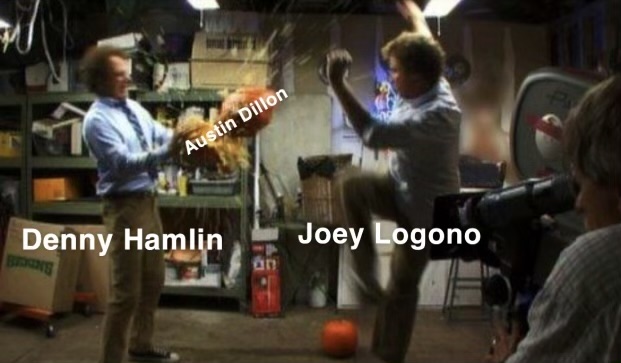
In the midst of Stage 3, Richard Childress Racing driver, Austin Dillon, made his way up through the field, making clean passes around veterans Joey Logano and Denny Hamlin for first and second. Dillon got around Hamlin on lap 373 and was en-route to win the race, fair and square. However, Ryan Preece was taken out by Ricky Stenhouse Jr. in Turn 1 with two laps to go, leading to one more restart after a caution. Despite Dillon taking the inside line (the fastest way around the track), Logano powered to the lead, taking the white flag half a car length ahead of Dillon. Out of Turn 3, Dillon throttled-up into Logano’s back bumper, spinning his #22 Shell-Pennzoil Ford out of the lead, giving Denny Hamlin the advantage to surge ahead. Someone on Dillon’s crew on the radio yelled at him to “wreck him” and his #3 Bass Pro Shops Chevrolet hooked the right-rear of Denny Hamlin’s #11 FedEx Toyota, sending him into the outside wall, leaving Dillon victorious and the bystanders of these aggressive antics frustrated. Dillon’s owner and grandfather, Richard Childress, denied the statement on the radio after the race, but the damage had been done (no pun intended).
The sanctioning body typically announces penalties on Tuesdays and Wednesdays after races take place on Sundays. NASCAR’s Vice President of competition, Elton Sawyer, made it clear after last night’s finish that this race was barely “crossing the line” and that they would look into the incident before Sunday’s Firekeepers Casino 400 at Michigan International Speedway. The issue with this incident is NASCAR has once again put themselves in a box. If you don’t penalize Austin Dillon, this gives drivers the green light to take matters into their own hands and potentially take things too far, which could lead to serious injuries or worse. Carl Edwards and Brad Keselowski had a feud that lasted two seasons and NASCAR did away with their “Boys have at it” catch phrase, after things got out of control with Edwards and Keselowski. Edwards was penalized after sending Keselowski upside down on his roof during a race at Atlanta Motor Speedway and Edwards was immediately parked for the rest of the event. NASCAR knew that things can get out of hand and will, if they leave it up to the drivers to take matters into their own hands.
Drivers themselves acknowledge that the current “playoff” championship format is to blame for the reckless antics of drivers over the years. 2014 marked the introduction of the elimination-style format, which has seen drivers do things out of desperation, slam other cars into the wall and put their hands on each other for the sake of “entertainment”. NASCAR is regarded by many as the highest level of professional auto racing in the United States and many local short tracks penalize drivers for pulling antics like Dillon’s last night. When is a line drawn? Where is the line? What precedent does this set for not only drivers in the Cup Series, but the other NASCAR feeder series?

 Every Man on Every Crew, LLC.
Leave a comment